Project management: why we split the build in two
The best decision we made about running the build was putting a break clause in the middle of it.
By Marc 3 min read
Who will build our Grand Design?
Choosing Clix to supply the SIP panels solved one problem and created another. Clix would put up the shell. But who would dig the hole, pour the concrete, build the roof, and fit out everything inside?
With a single building firm, that’s their job. We didn’t have a single building firm. We had a panel supplier and a lot of gaps around it.
Three ways to run a build
In the Alps, as anywhere, you can run a build in one of three ways:
- A turnkey builder. One firm does everything, for one price.
- A project manager (a maître d’œuvre), who finds and coordinates separate trades for each stage.
- Do it yourself. Possible, but not from another country, and not if you’d like to stay married.
Going with SIP meant option two. We needed a project manager to find the trades for the groundworks, the concrete and the carpentry, and to fit them all around the panels.
Split the contract in two
A build like ours falls naturally into two phases:
- Phase one: get the structure up and watertight.
- Phase two: the fit-out inside.
So we split the management contract the same way, with a break clause between the two. At the end of phase one we could carry on with the same project manager, or choose someone else for the fit-out.
If you’re building your own chalet, we’d strongly recommend it. The two phases need different skills. Phase one is about engineering, sequencing and weather. Phase two is about detail, finishes and a long list of trades. Not every project manager is equally good at both, and you won’t know until you’ve worked together.
Phase one: getting out of the ground
Once the architect’s plans were final, they went to Clix, who turned them into engineering drawings for the panels.
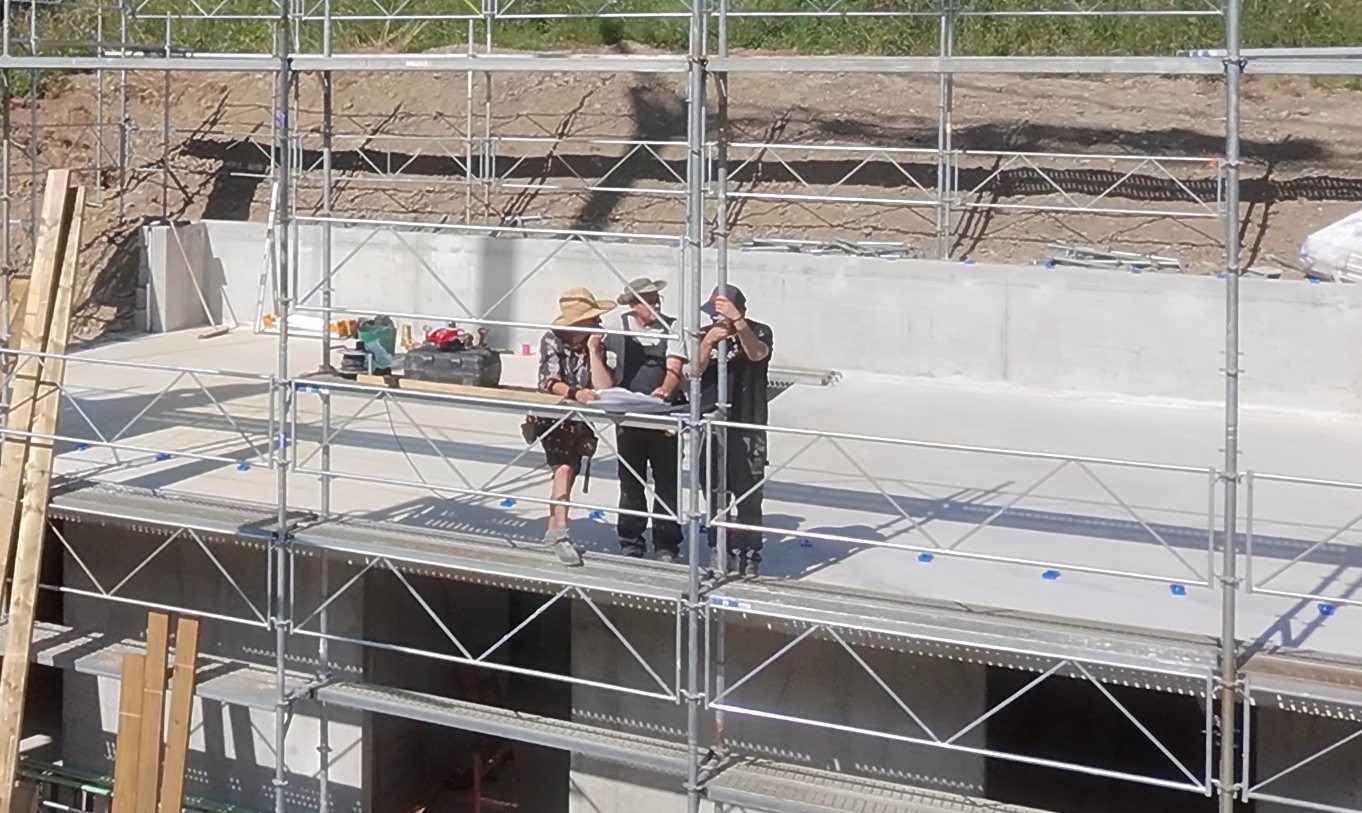
With our project manager’s help, we got quotes for the groundworks and concrete from three contractors. That meant more paperwork first: a soil survey and geotechnical plans, to decide how deep the foundations had to go and what the retaining wall at the back of the chalet needed to hold. (We tell that story in the groundworks chapter.)
Then the weather did us a favour. Winter ended early, and our preferred contractor could take us on as their first job of the year. The first machines arrived on site in April 2025: the project had started for real!
A little context
Do you need a project manager to build a chalet in France?
If you’re not using a single turnkey builder, effectively yes. A project manager (maître d’œuvre) finds and coordinates the separate trades and keeps the sequence on track. Choosing a SIP supplier rather than one builder meant we needed one.
Should you split a building contract into phases?
We’d recommend it. We split ours into structure-to-watertight and fit-out, with a break clause between them. That let us choose the right person for each phase rather than being locked in from day one.
What are the stages of building a SIP chalet?
Ours ran: engineering drawings from the panel supplier, soil survey, groundworks and concrete, the SIP shell, the roof and cladding to watertight, then the fit-out.
When does building work start in the Alps?
Usually once the snow clears in spring. Contractors book up fast, so being first in the queue matters. An early end to winter meant ours started in April 2025.